There’s a graph that every serious coach should have on their wall. It’s called the Yerkes-Dodson curve, and it maps the relationship between arousal and performance. The peak — optimal performance — sits right in the middle. Too little stimulation and you’re asleep. Too much, and you’re in panic mode. Neither end is where learning happens.
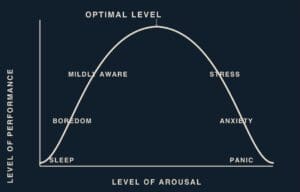
Most martial arts clubs are training people at the wrong end of that curve and calling it toughness.
The Problem With “Going Hard”
Heavy sparring has a reputation. In certain gyms, it’s a badge of honour — the harder the session, the better the training. But this is a fundamental misunderstanding of how human beings actually learn motor skills.
When sparring intensity spikes beyond a certain threshold, your nervous system stops being a learning machine and becomes a survival machine. Fight or flight kicks in. Cortisol floods the system. Adrenaline narrows your focus to one thing: don’t get hurt.
In that state, you will not experiment. You will not try the new technique you drilled on Tuesday. You will not take risks. You will revert to whatever works — the same jab, the same cover, the same panic response — and repeat it until the round ends.
You’re not sparring. You’re just surviving. And you can do that for years without improving.
The Chemistry of Learning
Here’s what’s actually happening inside your brain during a sparring session that’s gone too far.
Cortisol and adrenaline are high. Dopamine — the neurotransmitter most directly tied to motivation, reward, and the formation of new neural pathways — is dysregulated. And when dopamine isn’t functioning as it should, your capacity to learn is genuinely impaired. Not reduced. Impaired.
Neuroplasticity — the brain’s ability to form and reinforce new connections — requires the right neurochemical environment. That environment is characterised by engagement, curiosity, and enjoyment. It is not characterised by fear.
There is also the question of long-term physical cost. Unnecessary head trauma accumulates. The brain does not have an infinite tolerance for repeated impact, and a training culture that normalises heavy sparring as routine is quietly doing damage that doesn’t always show up immediately. Hard sparring has its place. Taking unnecessary punishment in a Tuesday night session does not.
If it’s not enjoyable, the learning is rubbish. That’s not a soft take. That’s neuroscience.
What the Best Fighters in the World Actually Do
Watch footage of Thai fighters training in Thailand. Watch Cuban boxers in the gym. These are two of the most technically sophisticated fighting traditions on the planet, and the thing that jumps out immediately is how playful their sparring looks.
Loose. Relaxed. Exploratory. Partners feeding each other opportunities rather than imposing dominance. It looks almost casual — until you realise the person doing it could dismantle almost anyone in the room.
That playfulness is not laziness. It is deliberate. It keeps arousal in the optimal zone where the brain is engaged but not overwhelmed, where dopamine is doing its job, where new patterns can actually be laid down and retained.
As fighters develop and techniques become ingrained, the need for heavy sparring actually decreases. At a certain level, reaction drills and technical flow work deliver more return than another hard round. The body already knows what to do. The job becomes refinement, not survival.
That said, competitive intensity absolutely has its place. Pre-fight preparation, pressure testing, learning to perform under stress — these are legitimate training goals. The difference is intention. You choose to raise the intensity for a reason, at the right time, with the right partner. You don’t make it the default.
The Animal Kingdom Gets It Right
This is visible throughout nature. Young predators learn to hunt through play. Cubs wrestle. Dolphins spar in the shallows. The intensity is real enough to develop genuine skill, but controlled enough that the animal stays curious, stays engaged, and keeps trying new things.
The moment genuine threat enters the picture, play stops and survival begins. The learning stops with it.
We are not so different. Spike the adrenaline too hard, make training genuinely frightening, and the brain stops being curious. It stops being creative. It falls back on the familiar and waits for the danger to pass.
This is why I think about white belts — regardless of their age — as cubs. They are early in their development. The priority is not pressure. It is play, exploration, and building positive associations with training. As they grow through the belt system, intensity can be introduced gradually and purposefully, matched to their development and their goals. You don’t throw a cub into a fight with a fully grown predator and call it education.
A Personal Note
Before I became a coach, I trained at a kickboxing club where the instructor had a habit of pairing me — a beginner — exclusively with an experienced black belt who had a significant ego and no interest in my development. Every session followed the same pattern: I was there to be dominated, not taught.
I trained like that for a year and learned almost nothing.
Not because I wasn’t working hard. But because my nervous system was in survival mode every single session. There was no space for curiosity, no room for experimentation, no safety to try something and get it wrong. And without that, there is no real learning — only repetition of whatever kept me from getting hurt.
Ego in sparring doesn’t just make training unpleasant. It actively destroys the environment that learning requires. A partner who needs to win every exchange is a partner who teaches you nothing.
Coaching the Individual, Not the Technique
Since becoming a coach, one of the things I’ve invested in most is understanding each student as an individual. My previous experience showed me what happens when a coach is technically proficient but has no interest in the person in front of them. I didn’t want to replicate that.
Every student who walks through the door has a different disposition, different strengths, and a different relationship with competition and pressure. Part of my job is reading that and working with it, not against it.
Some of my students have the mindset and physicality of kickboxers. Others are built for sport karate — fast, technical, point-oriented. Some have a natural affinity for grappling and I can see them competing in judo. And then there are students who have no interest in competition at all — hobbyists who train for the love of it — and some of those, I suspect, will make excellent coaches one day.
None of them benefit from being run through the same mould. All of them benefit from an environment where the arousal is managed, the ego is left at the door, and learning is actually allowed to happen.
What Good Sparring Actually Looks Like
It feels more like a conversation than a fight. There’s pressure — enough to keep you honest — but not so much that your brain switches off. You’re thinking. You’re experimenting. You’re making mistakes and immediately understanding why.
Keep arousal in the optimal zone. Keep dopamine doing its job. Keep it playful — and when the time comes to raise the intensity, do it with purpose.
That’s where fighters are actually made.
Osu.